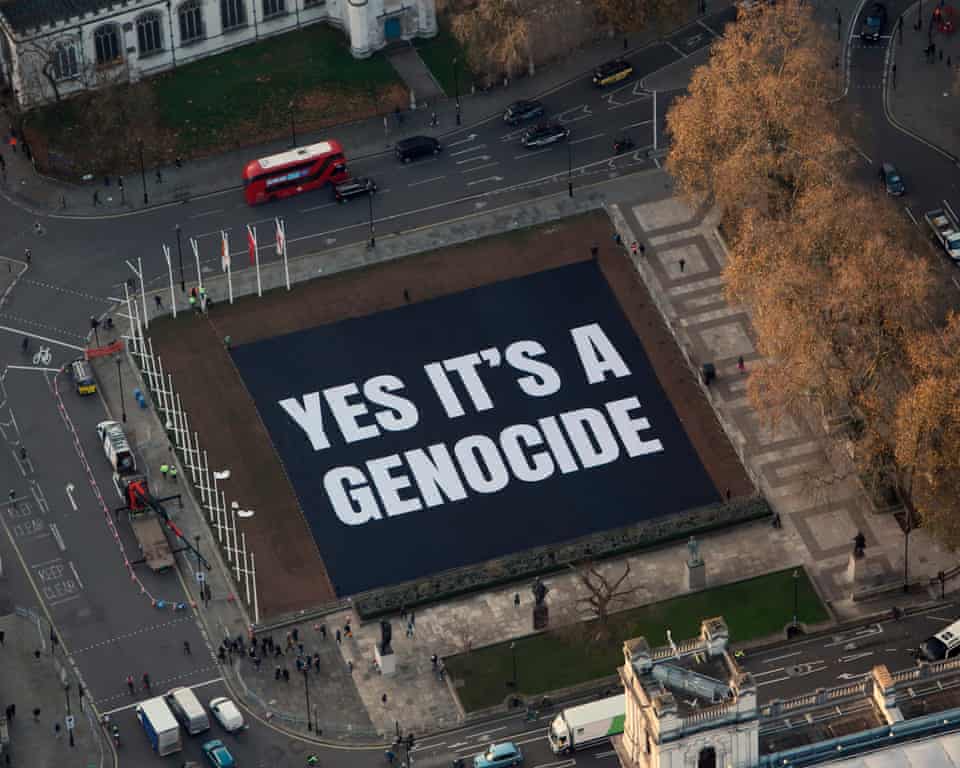
Campaign group Led By Donkeys has received £27,216 in compensation after Greater London Authority officials seized and destroyed a giant banner declaring “Yes It’s A Genocide” in Parliament Square.
The 40-metre by 40-metre banner was unfurled on 4 December 2024, more than a year into Israel’s assault on Gaza. GLA officials confiscated it at the scene, and Led By Donkeys spent the next 19 months trying to get it back. After initially refusing to return it, the GLA eventually admitted that it had handed the banner to the multinational waste company Veolia, which destroyed it.
The compensation only came after lawyers acting for Led By Donkeys demanded that either the GLA or Veolia cover the cost. Veolia has now agreed to pay £27,216. The payout doesn’t undo the censorship. It confirms that the authorities took property they had no right to destroy, suppressed a political message and only accepted financial responsibility once legal pressure made continued refusal more costly.
Ben Stewart, a co-founder of Led By Donkeys, said: “The Parliament Square banner was in collaboration with one of the world’s leading genocide scholars, but still the authorities threw process out the window and simply seized and destroyed our property. Pursuing compensation was never about the money, it was about defending space to protest Israel’s war crimes.
“Palestine protests are treated differently in Britain to all other forms of activism. Direct action is regarded as terrorism and words on a placard are rendered illegal. Over the years we’ve delivered banners, put up billboards and done guerilla projections across the country, but the only time our equipment has been seized and destroyed was when it related to Palestine.”
That difference in treatment isn’t an accident or an overreaction by a few officials. Britain is an imperialist state whose ruling class has armed, defended and politically supported Israel for decades. When a movement challenges that alliance, the supposedly neutral institutions of the state suddenly become far less tolerant. Police powers expand, protest rules tighten, speech is recast as extremism and even an enormous piece of cloth can become something the authorities feel entitled to seize and destroy.
The banner was filmed from the air and used in a social media video featuring Israeli Holocaust historian Prof Amos Goldberg, who said: “This is exactly what a genocide looks like.”
In September last year, the UN independent international commission of inquiry concluded that Israel was committing genocide in Gaza and that Israeli officials, including prime minister Benjamin Netanyahu, had incited these acts. Last month, the commission said Israel continued to commit genocide by deliberately targeting Palestinian children. Israel has denied the allegations, calling the earlier report “distorted and false” and the latest findings a “libellous sham”.
A substantial body of research by UN investigators, legal experts, rights organisations and genocide scholars has reached the same basic conclusion. Yet the British political establishment has treated the accusation of genocide as more dangerous than the destruction of Palestinian life itself. The problem, from the ruling class’s point of view, isn’t simply what Israel is doing. It’s that people in Britain are naming it clearly and drawing attention to the British state’s role in enabling it.
This repression reaches far beyond one banner. In February, the European Legal Support Center and Forensic Architecture launched an “index of repression” documenting more than 900 cases in Britain over six years in which Palestinian solidarity was “silenced, criminalised and sanctioned”. The cumulative effect is to raise the personal cost of opposing imperialism: workers risk arrest, job losses, disciplinary action, surveillance and public vilification for taking positions that threaten the foreign-policy interests of the ruling class.
The GLA said: “A banner seized by GLA heritage wardens following an unauthorised protest in December was unfortunately damaged during storage and subsequently disposed of by our contractors.”
Veolia offered a similar version: “We were asked by our client to collect the banner and store it temporarily at one of our local depots. Regrettably, after around 12 weeks, the banner’s condition deteriorated and became a health and safety hazard for our operations and the depot had to dispose of it. We have reimbursed Led By Donkeys for the full cost of the banner, due to the unintentional damage caused.”
This bureaucratic language drains the politics from what happened. The banner wasn’t an unfortunate item of damaged property. It was a political statement seized by public authorities during a protest against an imperialist war, passed to a private contractor and destroyed. Calling that process “unintentional damage” lets every institution deny responsibility while the censorship itself remains accomplished.
Led By Donkeys has recovered the financial cost of the banner, but the wider fight is over whether the British state can decide that solidarity with Palestine deserves a separate and harsher set of rules. The answer won’t come from compensation payments. It’ll come from building a movement strong enough to defend the right to oppose Britain’s imperialist alliances, name Israel’s crimes and keep Palestine visible despite every attempt to silence it.