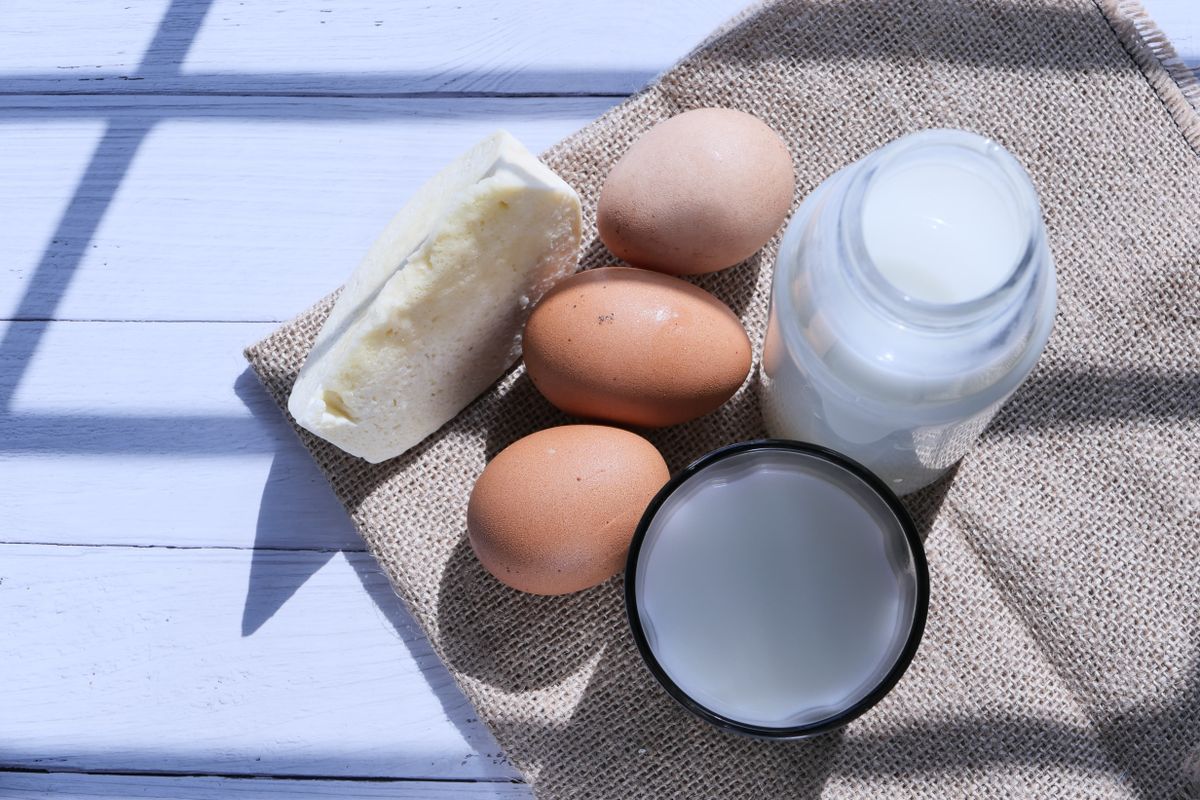
The Scottish government is consulting on plans to cap the prices of up to 50 essential food products, including milk, eggs, cheese and rice. Large supermarkets would have to offer at least one version of each product at the capped price. If it sold out, a similar product could also have to be sold at that price.
Ministers claim the supermarket chains will carry the cost. First Minister John Swinney has said he has a “public health responsibility” to ensure people can afford a healthy basket of food.
The prices and full list of products haven’t yet been decided. But the BBC has already found the real victim of the proposal: a business owner worried about his profit margin.
Its report opens and closes with Jamie Wyllie, an office holder in the National Union of Farmers in Scotland who runs several farms producing pigs, sheep and cereal crops. We hear about his sleepless nights, his energy bills and the administrative burden of running his businesses. Working-class people who can’t afford their weekly shop appear only as an abstract mass in the background.
No low-paid supermarket worker is interviewed. No agricultural labourer gets to explain what rising prices mean for their family. There isn’t a single parent describing which meals they skip when the money runs out. Their hardship provides the setting, but the farm owner gets to be the human subject of the story.
This is how class bias usually appears in bourgeois journalism. The facts don’t necessarily need to be false. The bias lies in whose fears are personalised, whose interests are treated as legitimate constraints and whose lives are reduced to statistics.
Wyllie’s concern that supermarkets will pass the cost down the supply chain is perfectly credible. Large retailers possess enormous purchasing power over smaller suppliers. If a cap limits what they can charge customers, they’ll attempt to protect their profits by lowering the prices they pay producers, cutting labour costs, reducing quality or shifting the burden elsewhere.
“I struggle to see how, or why, they would swallow that cost”, Wyllie said. “They’ll pass it down to us. We see it all the time”.
This is a good description of how capital behaves. Every capitalist is compelled to protect their own profitability and push costs onto somebody in a weaker position. It isn’t an argument against making food affordable. It’s an indictment of a system in which the production and distribution of basic necessities are governed by competing private interests.
But the BBC doesn’t draw that conclusion. Instead, it adopts the standpoint of the business owner and presents his profitability as a natural limit on what can be done.
Wyllie declares: “I’m the bottom of the food chain. I can’t pass my costs on to anybody else,” he added.
He isn’t the bottom of the food chain. However hard he works, Wyllie owns and runs several farms. The BBC even tells us that his options include changing what his farms produce or selling land for AI data centres. Workers don’t possess land that can be sold to technology companies. They don’t control what their workplace produces, and they can’t pass rising food, energy or housing costs on to anybody beneath them. They have only their labour power to sell.
The real bottom of this chain consists of farm workers, food-processing workers, warehouse staff, drivers and supermarket workers, followed by the millions of working-class households paying for the finished products. Whatever the precise scale of Wyllie’s business, the BBC is interviewing him as an owner defending his margin, not as a wage worker defending the price of his labour.
That doesn’t mean smaller agricultural proprietors have the same power as supermarket monopolies. They plainly don’t. Agricultural producers can be squeezed by banks, energy companies, fertiliser manufacturers, landowners and retailers. Their position in the market is much weaker than that of the corporations controlling access to millions of customers.
Capitalism doesn’t produce one harmonious “business community”. It produces conflict between different capitals, with the stronger monopolies imposing costs upon the weaker ones. Agriculture is also caught in an imperialist world market dominated by enormous corporations controlling energy, finance, fertiliser, machinery, logistics and retail distribution.
Yet these conflicts between capitalists mustn’t be confused with the conflict between capital and labour. A struggling proprietor and a supermarket conglomerate may occupy very different positions, but neither occupies the same class position as a worker dependent on wages.
The BBC blurs these distinctions through the vague category of “producers”. Owners, managers and workers disappear into a single group whose supposed common interest is protecting the farm’s bottom line. Once that class distinction is erased, the debate can be presented as a choice between helping consumers and protecting producers.
That isn’t the real choice. The real question is which class, or which section of capital, will be made to bear the cost.
A price cap could give working-class households some immediate relief. Food is part of the cost of reproducing labour power: workers must be able to feed themselves and their families before they can return to work and produce profit for an employer. Rising food prices therefore amount to an attack on the real value of wages.
But a price cap imposed only at the supermarket till leaves capitalist ownership and market power untouched. The retailer remains free to squeeze suppliers. Farm owners remain free to squeeze workers. Products can be made smaller, cheaper varieties substituted and labour costs cut. Capital will search the entire production chain for somewhere to recover the lost profit.
The Scottish government says supermarkets should take the hit, but it hasn’t explained how it will prevent them from transferring that cost. Its “fair food summit” will bring ministers together with organisations representing producers and retailers. Once again, organised business enters the room as an official stakeholder, while the proletariat appears mainly as the object of government policy.
Even the threat that farmland could be sold for AI data centres exposes the irrationality of capitalist production. Land and investment flow towards whatever promises the highest return, not whatever society needs most. If hosting servers is more profitable than producing food, capital directs resources towards servers. The market treats this as a rational decision even while families struggle to eat.
The BBC reduces all of this to a difficult balancing act for John Swinney. Its report praises the proposal as “bold”, speculates about legal hurdles and concludes that ministers must convince farmers like Wyllie that it can be introduced without hurting his bottom line.
That final concern gives away the article’s class standpoint. The ability of workers to afford food is treated as a political ambition to be balanced against competing demands. The property owner’s margin is treated as a material boundary that policy must respect.
The BBC doesn’t have to tell an outright lie to defend bourgeois interests. It only has to decide whose sleepless nights deserve a name, a face and a voic, and whose hunger remains scenery.