
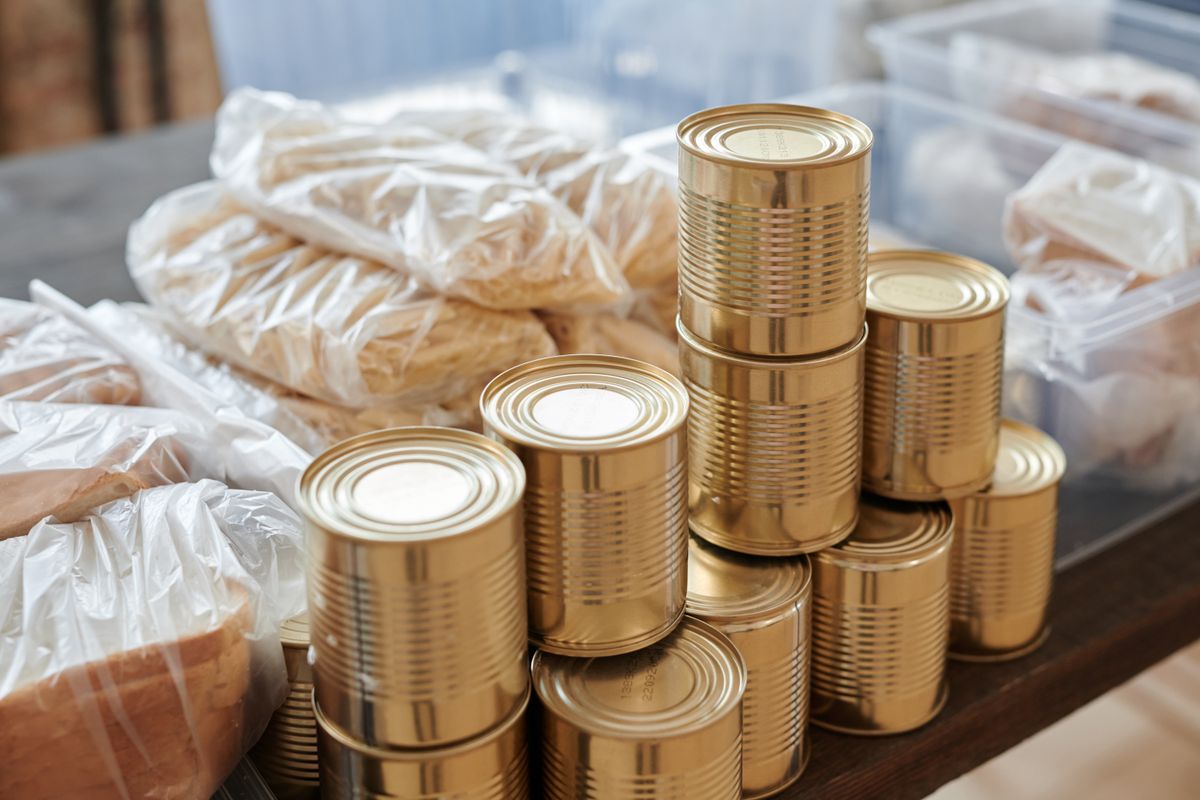
Food banks across north of Ireland are cutting the size of emergency parcels, reducing their opening hours and warning that they could close altogether as donations fail to keep pace with demand.
Enniskillen Foodbank in County Fermanagh has enough money for just “two months of running costs”, according to project manager Paul Dickson. Although the Trussell network can provide additional support for another three months, this offers only a temporary reprieve.
“That isn’t enough to last a year,” Dickson told BBC Radio Ulster’s Evening Extra.
“It’s brilliant to get that [support from the trust] but…we need to create network of relationships locally that help make food banks sustainable.”
At South West Belfast Foodbank on the Stewartstown Road, shortages have already forced workers to significantly reduce the amount of food placed in each parcel.
Edel Diamond, who works at the food bank, described the situation as “really upsetting because you’ve got families coming to you that aren’t really coping”.
“It seems to me like one cost-of-living crisis is just rolling into another and it doesn’t seem to have gone away,” she said.
This is what the so-called cost-of-living crisis looks like once the polite language is stripped away. Working-class families can’t afford enough food, while the organisations attempting to keep them alive can’t afford to continue operating.
According to the Trussell Trust, some food banks are now having to buy between 30 percent and 50 percent of the food they distribute. An emergency system supposedly sustained by voluntary donations is being forced to purchase nearly half its own stock while also paying for buildings, energy and transport.
Food banks are effectively being made to operate as an unofficial arm of the welfare system, but without guaranteed funding, public infrastructure or any legal obligation on the state to keep their doors open. The British state withdraws support and leaves charities to manage the resulting hunger.
That arrangement depends heavily upon donations from other working-class people. When wages and benefits lose value while food, rent and energy become more expensive, those regular donations inevitably shrink. People who once put an extra £5 or £10 of food into a supermarket collection point are now struggling to fill their own cupboards.
“Our lifelong contributors, they would give us £5 of food or £10 of food every time they go to shop in a supermarket,” said Fiona Cole, the Trussell Trust’s policy and public affairs manager in north of Ireland.
“That £10 of food is just simply not the same amount as what you would have got even six months ago.”
This exposes one of the central contradictions of charity under capitalism. Food banks redistribute resources within the working class, taking donations from those with slightly more to feed those with nothing. As the crisis spreads and living standards fall more broadly, the base supporting that charitable system is weakened as well.
The wealth of landlords, energy companies, supermarket owners and other sections of capital remains protected. Their claims on a household’s income come first. Food becomes whatever can be bought with what remains.
Under capitalism, food isn’t distributed according to need. It’s produced and circulated as a commodity. A family’s access to it depends on money, even where society possesses more than enough productive capacity to feed everyone. Hunger therefore exists alongside full supermarket shelves because the purpose of production is profit, not the satisfaction of human need.
Food banks help reproduce labour power at the lowest possible cost to capital and the state. When wages and benefits don’t cover the cost of keeping workers and their families alive, charity is expected to fill the gap. The food bank itself isn’t responsible for that exploitation; its workers and volunteers are responding to immediate human suffering. But its permanent necessity is useful to a ruling class which has no intention of guaranteeing everyone a decent standard of living.
“Part of the Trussell ethos is that we don’t believe that we should be needed, but unfortunately, we are needed at the minute and we need to be here for the people that rely on us,” Dickson said.
In 2025, Trussell food banks distributed 67,851 emergency parcels across north of Ireland, including 26,459 for children. Parcel distribution was lower than at the 2023 peak, and the trust says wider evidence indicates there had been some corresponding fall in need. But a decline from the height of a crisis isn’t the abolition of that crisis. Tens of thousands of emergency parcels were still required, while food banks are now reporting a renewed and acute shortage of stock.
During the past four to six weeks, three food banks have directly contacted the Trussell Trust with concerns about their finances and supplies. Six have issued emergency appeals through social media. Some have closed distribution centres or reduced their opening hours.
“Our biggest fear is that our food banks are prematurely forced to drastically reduce their support, or worse, close their doors because the income they receive falls short and they can no longer afford their household essentials,” Cole said.
The crisis can’t be separated from the political economy created by partition and British rule. Working people in the north remain subject to decisions made within a state centred on Westminster, while Stormont administers public services and poverty within the limits of that settlement. Politics is repeatedly organised around competing constitutional and sectarian blocs, while the shared class conditions beneath them remain intact.
Food poverty crosses those divisions. Neither a Union Jack nor a tricolour placed over the existing capitalist order can make wages cover the cost of living or turn food from a commodity into a guaranteed human necessity.
“We’re not just a food bank, we are places of comfort for people, places where people can come and find that hope,” Diamond said.
“We want to see the end for the need for food banks, but at this immediate time we are in crisis and we’re urgently appealing for donations of food and finance.”
Those donations may keep individual food banks operating for another few weeks or months. They can’t resolve the contradiction that is emptying their shelves. As working-class households are squeezed together, the donation bucket empties. Capitalism can organise abundance for sale and poverty for those unable to pay, then leave exhausted volunteers to keep its casualties alive.