Two men and a 16-year-old boy have been arrested as far-right demonstrators returned to Portsmouth for a second weekend to protest against immigration.
The mobilisation followed the interception last Sunday of a small boat carrying 140 people seeking asylum. Far-right activists attempted to prevent those onboard from being processed, while police officers were assaulted and official vehicles damaged.
A 76-year-old man from Southampton was arrested on suspicion of concealing his identity after police ordered protesters to remove face coverings under powers contained in the Crime and Policing Act. A 33-year-old man from Portsmouth was arrested on suspicion of obstructing a highway. The 16-year-old, also from Portsmouth, was arrested on suspicion of violent disorder relating to the previous weekend’s events.
Del Leon Somerville, 42, has separately appeared before Portsmouth magistrates charged with violent disorder and assaulting a police constable. Police said his arrest was expected to be the first of several arising from last Sunday’s disorder.
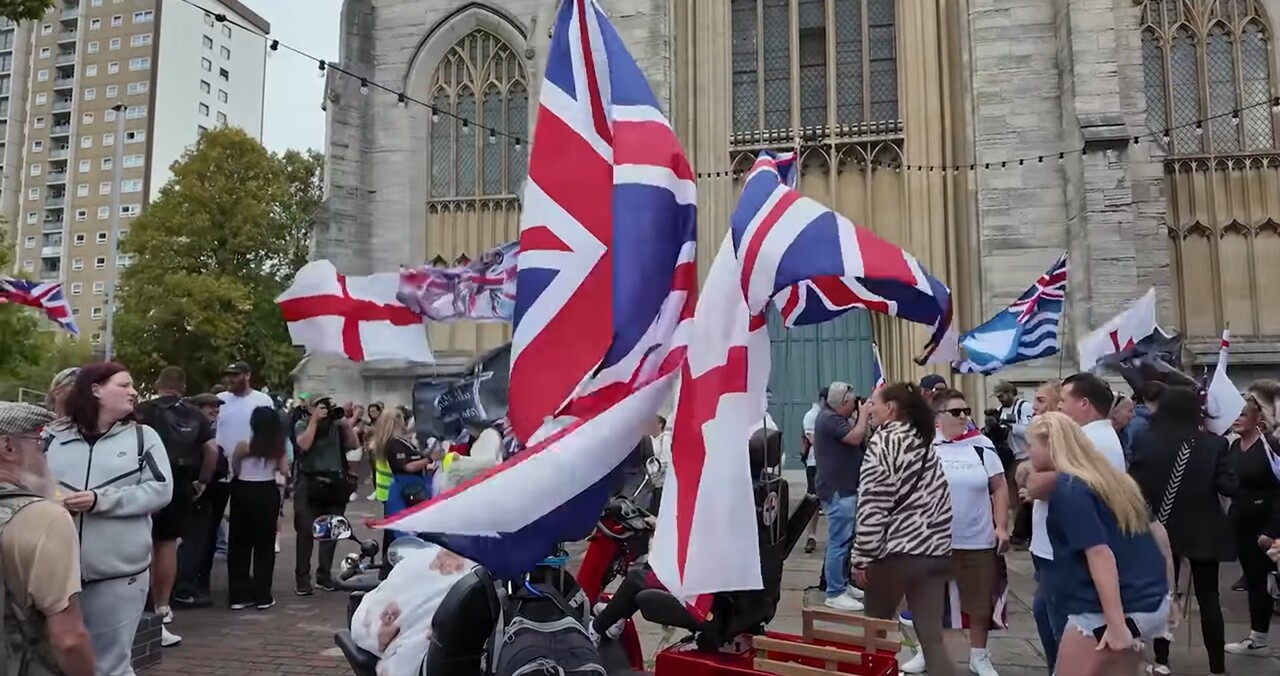
A large police operation separated the far-right mobilisation from a counter-protest in Portsmouth city centre. Union flags and Portsmouth Patriot clothing were prominent among the anti-immigration crowd outside All Saints Church. One man led chants of “stop the boats” and claimed the protest was against “illegal men invading the shores”.
Nearby, counter-protesters carrying Stand Up to Racism and Refugees Welcome banners displayed signs reading “RNLI are heroes, no one is illegal” and “stop pretending your racism is patriotism”.
The language of “invasion” shows the political purpose of these demonstrations. The people aboard the boat disappear as human beings and are reconstructed as a hostile army. Once that lie has been accepted, surrounding frightened and exhausted people, preventing them from being processed and attacking those who rescue them can all be presented as acts of national defence.
This is why the far right wraps itself in the union flag. Nationalism conceals the real divisions running through British society. It pretends that British workers share a common interest with British landlords, employers and billionaires, while presenting displaced workers from elsewhere as an enemy. But people arriving in small boats didn’t suppress wages, privatise public services, inflate rents or strip working-class communities of resources. Those things were done by the British ruling class.
Capital moves across borders whenever a profit can be made. Companies shift production, investors buy property and finance extracts wealth from entire countries without being denounced for “invading”. Workers and displaced people, meanwhile, are subjected to walls, detention centres, naval patrols and an increasingly dangerous system of border enforcement. The freedom of movement celebrated by capitalism is primarily the freedom of capital.
Britain’s imperialist ruling class also wants migration discussed without any examination of imperialism. Its wars, sanctions, arms exports and participation in an international system that drains labour and resources from poorer countries are treated as irrelevant background. People are displaced by the world capitalism has created and are then punished for crossing the borders drawn and defended by its strongest states.
Small boat crossings have fallen by more than 40 percent compared with the same period last year. Smuggling operations have responded to enforcement by launching boats from more distant parts of the French coast, making already dangerous journeys even more hazardous. Yet the decline in crossings hasn’t weakened the far-right campaign. Its purpose isn’t to respond rationally to the scale of migration. It’s to manufacture an internal enemy onto whom the crises of British capitalism can be displaced.
The abuse directed at RNLI volunteers makes this particularly clear. Saving people from drowning has itself been presented as a political betrayal. Border nationalism depends upon suffering being visible enough to act as a deterrent, meaning even the most basic act of preserving human life becomes intolerable to its supporters.
A related mobilisation took place at Glasgow Green, where the anti-immigration Pink Ladies movement was opposed by a counter-protest involving Stand Up to Racism. Scottish Trades Union Congress general secretary Roz Foyer and MSPs Alison Thewliss and Iris Duane attended the counter-protest. Reform UK’s deputy leader in Scotland, Thomas Kerr, and Reform councillor Audrey Dempsey appeared at the Pink Ladies event.
The presence of Reform figures demonstrates how street reaction and parliamentary reaction feed one another. Reform gives anti-migrant agitation an electoral form, while demonstrations create the appearance of a popular movement demanding still more repression. Both direct working-class anger away from the people who own and govern Britain and towards those with the least power over its conditions.
Police imposed separate gathering areas and routes on the opposing groups. Hampshire police said: “We will support those who want to express their views peacefully and lawfully, but we will not tolerate those whose only aim is to create fear and incite violence.”
Police and crime commissioner Donna Jones claimed the order to remove face coverings was implemented “equally and impartially for everyone involved” and promised that the power would be used “proportionately in the future for both sides of the spectrum of protesters.”
But anti-racists opposing an organised threat and reactionaries attempting to terrorise asylum seekers aren’t two equivalent “sides of the spectrum”. One is resisting racial scapegoating; the other is helping turn displaced people into targets. Treating them as interchangeable public-order problems strips the conflict of its class and political content.
The government condemned the previous weekend’s “intimidating and thuggish behaviour”, while home secretary Shabana Mahmood described the balaclavas worn by some demonstrators as communicating “a fear factor and obvious malign intent”. But condemning street disorder doesn’t amount to breaking with the politics that produced it.
The far right didn’t invent the obsession with borders, boats and supposedly threatening outsiders. It takes ideas cultivated by governments and the bourgeois press and pushes them to their most openly violent conclusion. Ministers turn human beings into statistics and security threats; reactionaries carry that message into the streets; the police then manage the resulting disorder while acquiring broader powers over protest.
The 140 people brought into Portsmouth didn’t create Britain’s housing crisis, falling living standards or collapsing public services. Directing popular anger towards them protects the class that did. That is the far right’s function: to take misery produced by capitalism and turn it into hatred of people capitalism has already dispossessed.