
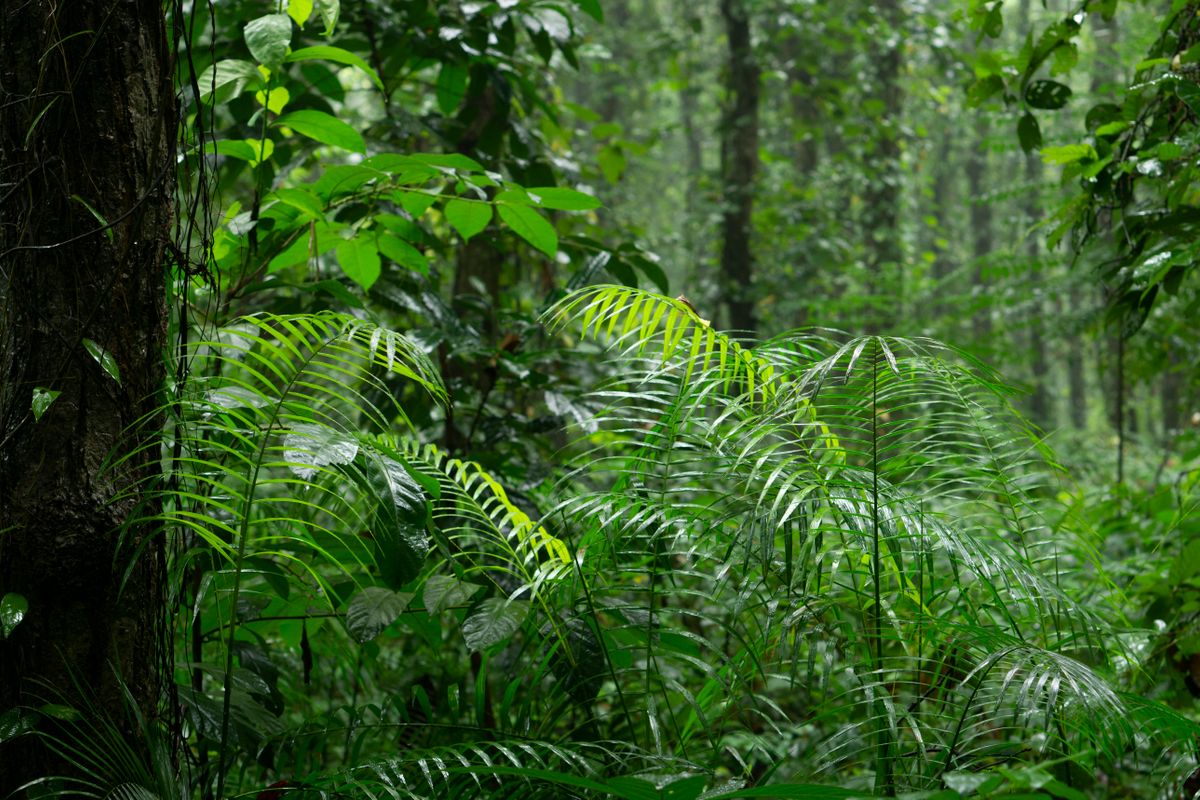
Natural forest regeneration can restore tropical ecosystems while costing up to 96 per cent less than conventional tree-planting programmes, according to new research from the University of Queensland and the University of Newcastle.
The study found that allowing forests to regrow naturally could deliver substantial benefits for both carbon storage and biodiversity. Researchers mapped how the costs and benefits varied across the tropics, identifying regions where natural regeneration could produce the greatest results at the lowest cost.
“Nature is a great gardener, sometimes we just need to get out of its way while providing a bit of support,” said School of the Environment PhD candidate Jiaqi Li.
“For tree planting you need to purchase the seeds and hire workers or recruit volunteers to plant and manage them, which is costly.
“For natural regeneration people just need to check the land for invasive species and remove them, check there is adequate seed sources, put up protection from fire, grazing animals, and humans and then it is mostly self-sufficient.”
Natural regeneration isn’t simply a matter of abandoning degraded land. It requires protection from further clearing, fires and grazing, along with monitoring to ensure that native vegetation can return. It also won’t work equally well everywhere. Land without nearby seed sources or with severe ecological damage may still require direct intervention.
But where the conditions are suitable, natural forests can outperform the regimented plantations commonly promoted by governments and corporations.
“For many cases of natural regeneration, studies show that you can end up with a forest that could store more carbon and is more biodiverse than a planted forest,” Li said.
This cuts through much of the spectacle surrounding corporate tree-planting campaigns. Planting rows of trees produces convenient figures for annual reports and advertising. It allows corporations to boast that they have “offset” their emissions while continuing to extract fossil fuels, clear land and expand production. But a plantation designed to generate credits or commercial timber isn’t the same thing as a living forest.
Between 2000 and 2012, tropical forests were reduced globally by 2.3 million square kilometres. This released an estimated 0.86 gigatons of carbon annually and threatened the well-being of around 1.5 billion people who depend upon forests.
This destruction isn’t the work of an abstract and classless “humanity”. Tropical forests are cleared because land, timber, minerals, crops and livestock can be turned into profit. Agribusiness, mining and logging capital see a forest not as a life-support system but as an accumulation of commodities waiting to be extracted.
“Forests are Earth’s life support systems and tropical forests are the most biodiverse amongst all the forest types, covering 18 per cent of the land and home to more than half of all land vertebrate species,” Li said.
“They are also a giant carbon sink, so when deforestation happens we not only stop the forest up taking the carbon, but we also flip it and turn it into a carbon source.”
Much of the destruction is concentrated in countries that spent centuries subjected to colonial plunder and remain subordinated within the imperialist world economy. Forests are cleared to supply richer markets, while the cost of repairing the damage is pushed onto countries whose development has been constrained by debt, unequal trade and foreign corporate power.
This doesn’t absolve domestic capitalists or the states that grant concessions and suppress resistance to land grabs. It identifies the system connecting them: a world market dominated by monopoly capital, in which the environmental costs of accumulation are dumped on workers, peasants, Indigenous peoples and oppressed nations.
The researchers identified “holistic hotspots” where natural regeneration could provide high carbon and biodiversity benefits at comparatively low cost. These were mostly found in Indonesia, Madagascar, the Philippines, Mexico and Malaysia. The greatest potential carbon benefits were found around the Amazon basin and in areas including Borneo, Sumatra and Papua New Guinea, while particularly strong biodiversity benefits were identified in the Afrotropics, including Madagascar.
Under the 2022 Kunming-Montreal Global Biodiversity Framework, countries pledged to restore 30 per cent of the world’s degraded land. Yet even comparatively inexpensive restoration is running into the limits imposed by capitalist priorities.
“Restoring forests is expensive and the cost could mean some nations can’t meet their ambitious restoration goals,” said senior author Dr Brooke Williams.
The contradiction isn’t a lack of scientific knowledge or physical resources. Capitalist states routinely find enormous sums for banks, corporations and weapons, while treating the preservation of the natural world as an unaffordable burden. Restoration is accepted only when it can be made cheap, profitable or useful as a new market for carbon credits.
The study shows that nature retains an immense capacity to repair itself. The real obstacle is social. Under capitalism, a recovering forest appears as idle land, while a forest converted into timber, mines, plantations or grazing territory becomes a source of revenue. Its use value as a living ecosystem is subordinated to its exchange value.
Forests can regenerate once the forces destroying them are removed. Capital can’t stop destroying them of its own accord, because endless accumulation isn’t a policy choice or a moral failure. It’s the law by which the system lives.