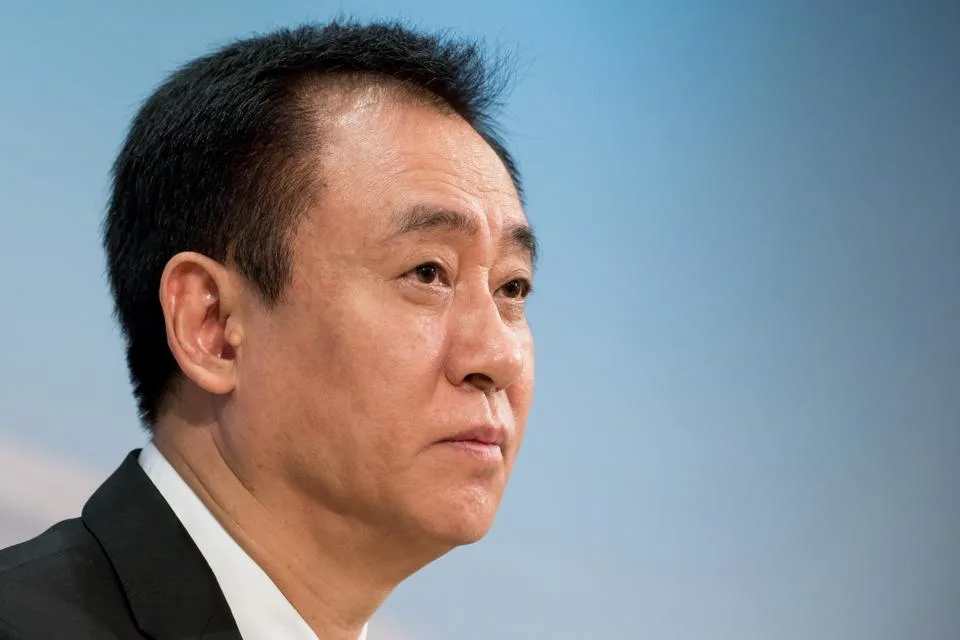
China has sentenced Evergrande founder Hui Ka Yan to life in prison for bribery, fraud and falsifying financial information, bringing down one of the country’s most powerful private capitalists.
The Shenzhen court also imposed an 8.82 billion yuan ($1.3 billion) fine on China Evergrande Group and a separate 7 billion yuan fine on its mainland unit. All of Hui’s personal assets will be confiscated.
According to Xinhua, the sums involved were “exceptionally large” and the offences were “particularly heinous.” The court found that Hui and his companies had caused staggering economic losses and widespread harm to society.
Hui was once the richest man in Asia, with a fortune estimated at $45.3 billion. Evergrande became China’s largest property developer by sales through a debt-fuelled expansion financed by banks, domestic and international bond markets and even the company’s own employees.
The model began to collapse around 2021, when Evergrande missed bond payments and exposed the scale of the debt buried beneath its property empire. The company eventually accumulated liabilities of more than $300 billion.
Evergrande’s attempts to restructure failed. In 2024, a Hong Kong court ordered the company to be liquidated after describing its restructuring proposal as “scant.” It was delisted from the Hong Kong Stock Exchange the following year. Liquidators are still attempting to recover assets from the collapsed company and from Hui’s former wife, Ding Yumei, who reportedly lives in London.
Hui had been in custody since late 2023 and pleaded guilty in April to charges including bribery and fundraising fraud.
Another 56 people connected to Evergrande received prison sentences ranging from 22 months to 18 years. They include Hui’s sons, Xu Tenghe and Xu Zhijian. The charges against the group include fraud and illegally raising money from the public.
The bourgeois press describes Evergrande as the symbol of a property “boom and bust,” as though this were a natural cycle like the changing of the seasons. But there was nothing natural about it. Evergrande was built through private accumulation, financial speculation and the treatment of housing as a commodity from which fortunes could be extracted.
Hui’s wealth wasn’t created by his own labour. It rested on land, construction work, credit and the future incomes of countless other people. Evergrande borrowed on an enormous scale, shifted risk onto employees and creditors, and used its growing size to attract still more money. Hui became a billionaire while the liabilities were spread throughout society.
This is what capital does when it’s allowed to move according to its own logic. Every capitalist is driven to expand or be overtaken by competitors. Credit allows that expansion to race far ahead of the value actually produced, while ownership concentrates the rewards at the top. When the structure collapses, the capitalist class tries to leave workers, small investors and the public holding the wreckage.
The Evergrande crisis exposed the contradictions created by the use of market mechanisms within China’s socialist economy. Private property developers were permitted to play a major role in urban development, and with that came speculation, corruption and reckless accumulation. But China’s capitalists weren’t granted the political right to place themselves above the state or make society responsible for whatever losses they created.
Beijing’s restrictions on debt-fuelled expansion punctured Evergrande’s model. When the company’s finances unravelled, its enormous size didn’t entitle Hui to dictate terms. His former status as Asia’s richest man didn’t protect him from prosecution, the confiscation of his fortune or life imprisonment.
The contrast with capitalist countries is hard to miss. In Britain, the United States and the rest of the imperialist core, people who defraud the public on a massive scale usually face little or no personal punishment. The financial crash of 2008 destroyed jobs, homes and public services across entire countries, yet almost all the bankers and executives responsible kept their fortunes and freedom. Their institutions paid negotiated fines, governments rescued the financial system with public money, and the working class was handed the bill through austerity.
This isn’t because Western financial schemes are less harmful. It’s because the capitalist class holds state power. Its law can punish an individual capitalist who becomes inconvenient, but it protects the system of exploitation and speculation from which the whole ruling class draws its wealth. Corporate fines become another cost of doing business. Senior executives retire with their property intact, while crimes committed on behalf of accumulation are renamed “risk-taking,” “regulatory failures” or “market excesses.”
That’s why Western coverage so often describes serious action against Chinese billionaires as an ominous “crackdown.” The assumed right of private wealth to command the state is treated as freedom, while the subordination of capital to public authority is presented as arbitrary repression.
Hui’s sentence doesn’t erase the losses caused by Evergrande, nor does it make the contradictions produced by commodity housing disappear. It does, however, establish something unthinkable in most capitalist states: ruining thousands of people through fraud and corruption can cost a billionaire not merely his position, but his fortune and his freedom.
Hui rose to a net worth of more than $45 billion by commanding a private property empire. He’ll now spend the rest of his life in prison, with his assets confiscated and his companies facing billions in fines. In China, being a billionaire didn’t make him untouchable.