
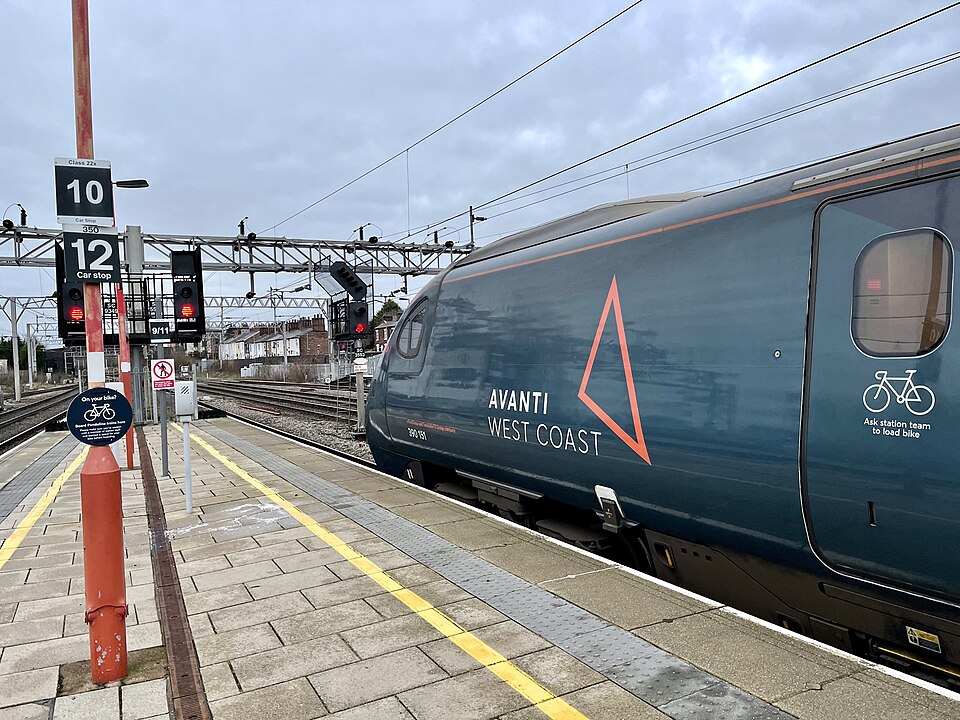
Train drivers at Avanti West Coast have secured an above-inflation pay rise after their union threatened strike action across some of Britain’s busiest rail routes.
The agreement between Avanti and the Associated Society of Locomotive Engineers and Firemen (Aslef) gives drivers a 3.6 percent pay rise — 0.7 percentage points above the latest inflation rate. Drivers will also receive time and a half for working Sundays and £720 if they work a fifth day in the week.
The deal was reached on Saturday and is the first of its kind to be approved under Andy Burnham’s premiership. It covers services connecting London with Manchester, Birmingham, Glasgow, Liverpool and other major cities.
Aslef announced in June that it planned to ballot members over possible strike action. The ballot threat was enough to bring about a settlement, making the source of the pay rise perfectly clear. It wasn’t granted out of generosity by Avanti’s management or handed down as a favour by the government. It was secured because organised workers demonstrated that they were prepared to withhold their labour.
Under capitalism, employers constantly try to hold wages down while extracting as much work as possible. Individual workers have little power within this relationship. A railway driver can’t bargain as an equal with a large company or the state. When workers organise collectively, however, the balance begins to shift. A strike turns labour power from something sold individually into a weapon held collectively.
Rail workers occupy an especially powerful position because the railway is essential to the daily movement of millions of people. Avanti operates the main London-Manchester route, which is expected to carry increased ministerial traffic following the creation of the No 10 North office. Its trains also connect some of Britain’s largest cities. Even the threat of disruption therefore carries an immediate economic and political cost.
The inconvenience caused by a rail strike is routinely used to attack railway workers. In reality, that disruption demonstrates how socially necessary their work is. If train drivers can bring large parts of the country to a halt by staying home, their labour plainly deserves more than employers would willingly pay for it.
The 3.6 percent increase is a modest real-terms gain, not the great giveaway portrayed by the right. After years in which inflation repeatedly cut the value of workers’ wages, merely beating the current rate by 0.7 percentage points hardly amounts to extravagance. The additional payments also compensate drivers for giving up Sundays or working beyond their normal four-day week.
Avanti is due to be taken into public ownership by spring 2027, with the remaining passenger operators expected to follow by the end of that year. The company currently has the worst punctuality record of any major British rail operator, according to Office of Rail and Road figures. It has repeatedly cut services, including the 7am Manchester-to-London train, which it removed and then restored within days following public criticism.
The failure of Avanti exposes the familiar record of railway privatisation: unreliable services, repeated cuts and worsening conditions, all overseen by companies whose first concern is preserving the commercial operation rather than meeting social need.
Renationalisation will remove the private operator, but public ownership under a capitalist state isn’t the same thing as workers’ control or socialist ownership. Railway workers will still sell their labour for wages, managers will still attempt to contain costs and services will still be judged according to Treasury priorities. The settlement was won through the power of the union, not simply because the operator is scheduled to change hands.
The government said it had “prioritised resolving the rail union disputes, improving services for passengers and saving hundreds of millions in lost revenue to ease the burden on taxpayers”.
Even while agreeing to the settlement, ministers framed avoiding a strike primarily as a matter of protecting revenue and taxpayers. Workers appear in this language as another cost to be managed, despite being the people whose labour keeps that revenue flowing.
The Tory response was more openly hostile. Shadow transport secretary Richard Holden accused the government of “totally capitulating to their union paymasters” and claimed that “taxpayers are being asked to stump up millions simply to save Burnham’s blushes”.
The phrase “union paymasters” turns reality on its head. A trade union consists of workers pooling their resources to defend their shared interests. The drivers are also taxpayers, while passengers depend on their labour every day. Yet paying workers slightly more than inflation is presented as an intolerable burden. Money spent on wages becomes a scandal, while the costs produced by privatisation, service cuts and mismanagement are treated as the natural order of things.
An Aslef spokesperson said: “Our job is to enhance our members’ terms and conditions and this deal, struck with Avanti West Coast and approved by the DFTO (Department for Transport Operator), has been accepted.”
The Department for Transport said: “We are pleased to see Avanti West Coast work with Aslef to enable a fair and affordable settlement to keep Britain’s railways moving and prevent disruption for passengers.”
Avanti’s drivers didn’t win because the company suddenly discovered fairness. They won because their organisation gave them the ability to disrupt the railway and impose a cost on those refusing their demands. The settlement is a limited economic gain, but it records a basic truth of the class struggle: workers receive concessions when they possess the collective power to make refusal more expensive than agreement.