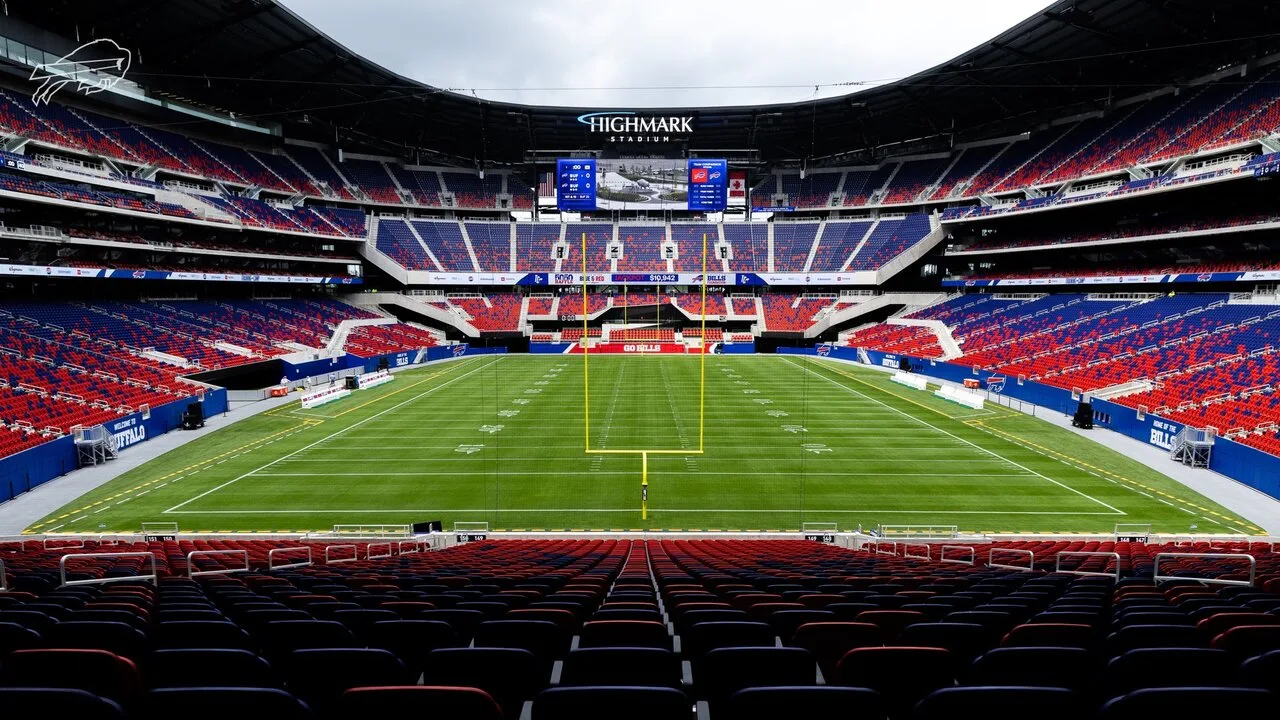
The Buffalo Bills played their first preseason game at the new Highmark Stadium on Saturday. Season ticketholders got an early look during an open practice last week, and many didn’t like what they saw.
Photos shared on social media showed railings and cables blocking the field from some seats. But the obstructed views are only the most visible part of the problem. The larger issue is the price working people are being charged to enter a stadium they already helped pay to build.
Highmark Stadium cost $2.2 billion, including $850 million in taxpayer funding. After the public covered that enormous subsidy, Bills fans were hit with higher ticket prices and personal seat licenses, or PSLs.
A PSL isn’t a ticket. It merely gives a fan the right to buy season tickets. At Highmark, that right costs between $750 and $50,000 per seat. The tickets themselves cost extra and, for comparable seats, can be twice as expensive as they were in the old stadium.
The arrangement is a clean example of how capitalist ownership works: costs are socialized while profits remain private. Public money pays for construction, infrastructure and risk. Private capital controls the finished product and charges the public for access.
This isn’t a distortion of the capitalist market. It’s the normal operation of monopoly capital in the imperialist center, where corporations use the state to secure profitable conditions they couldn’t obtain on their own. The state acts as the organizer and protector of ruling-class interests, then presents the resulting transfer of wealth as a public investment.
The Bills reportedly raised about $250 million from PSL sales for the new 60,000-seat stadium, according to Sportico reporter Kurt Badenhausen. That averages roughly $4,000 per seat, collected before a single season ticket is purchased.
PSLs are especially attractive to NFL owners because the league requires teams to share ordinary ticket revenue. Money collected through PSLs doesn’t have to be shared. Teams can keep all of it.
Every NFL team opening a new stadium has used PSLs since the Carolina Panthers introduced them at Ericsson Stadium in 1996. What looks like a fee imposed on individual fans is really an organized method of extracting more money while avoiding the league’s revenue-sharing system.
More of the same is coming. Five other NFL teams are planning new stadiums over the next five years: the Chicago Bears in Hammond, Indiana, along with teams in Cleveland, Kansas City, Tennessee and Washington, DC. These projects are likely to bring more PSLs, higher ticket prices and additional premium seating, with fewer affordable seats left for ordinary fans.
During the NFL’s last major stadium-building boom, the average ticket price rose by about 30 percent in a team’s first year inside a new stadium, according to Victor Matheson, an economics professor at the College of the Holy Cross. He expects increases of at least that size this time, along with more expensive PSLs.
The industry’s defenders point to wider seats, improved concourses and better concessions. Marc Ganis, a sports business consultant who works with the NFL and several teams, put the sales pitch plainly: “At least theoretically, everything related to the fan experience will be better.”
But “the fan experience” doesn’t mean the same thing for every class. Under capitalism, improvements are directed toward those able to pay the most. The stadium’s use as a place where tens of thousands of people can watch football becomes secondary to its exchange value as a machine for producing premium revenue.
Amenities also take up space, and the number of seats is shrinking. The old Bills stadium held 71,600 people. The new one holds 60,000 — a reduction of 11,600 seats. Cheap seats are disappearing while premium areas expand.
Strong demand makes this strategy even more profitable. The Bills’ website shows that no season tickets remain available. The NFL hasn’t added franchises, and its stadiums aren’t becoming larger, so the total number of tickets has remained fairly constant. Owners can therefore restrict supply while charging more for what remains.
After complaints about obstructed views appeared online, Bills executives said many of the affected seats would be sold for concerts rather than football games. They also said fewer than 1 percent of fans had complained.
That percentage turns a concrete problem into a small-looking statistic. It doesn’t make the railing or cable disappear.
“It might be a small percentage of people, but its still a lot of people,” Badenhausen said. “For those 600 or so fans, it’s a 100 percent of their seats being obstructed.”
Highmark’s blocked sightlines aren’t separate from the stadium’s economics. They are those economics made visible. The public supplied $850 million. Fans paid again for the right to buy tickets. Affordable capacity contracted, while the team kept hundreds of millions in PSL revenue.
Working people financed the spectacle. Capital enclosed it. Some of the people paying the bill can’t even see the field.