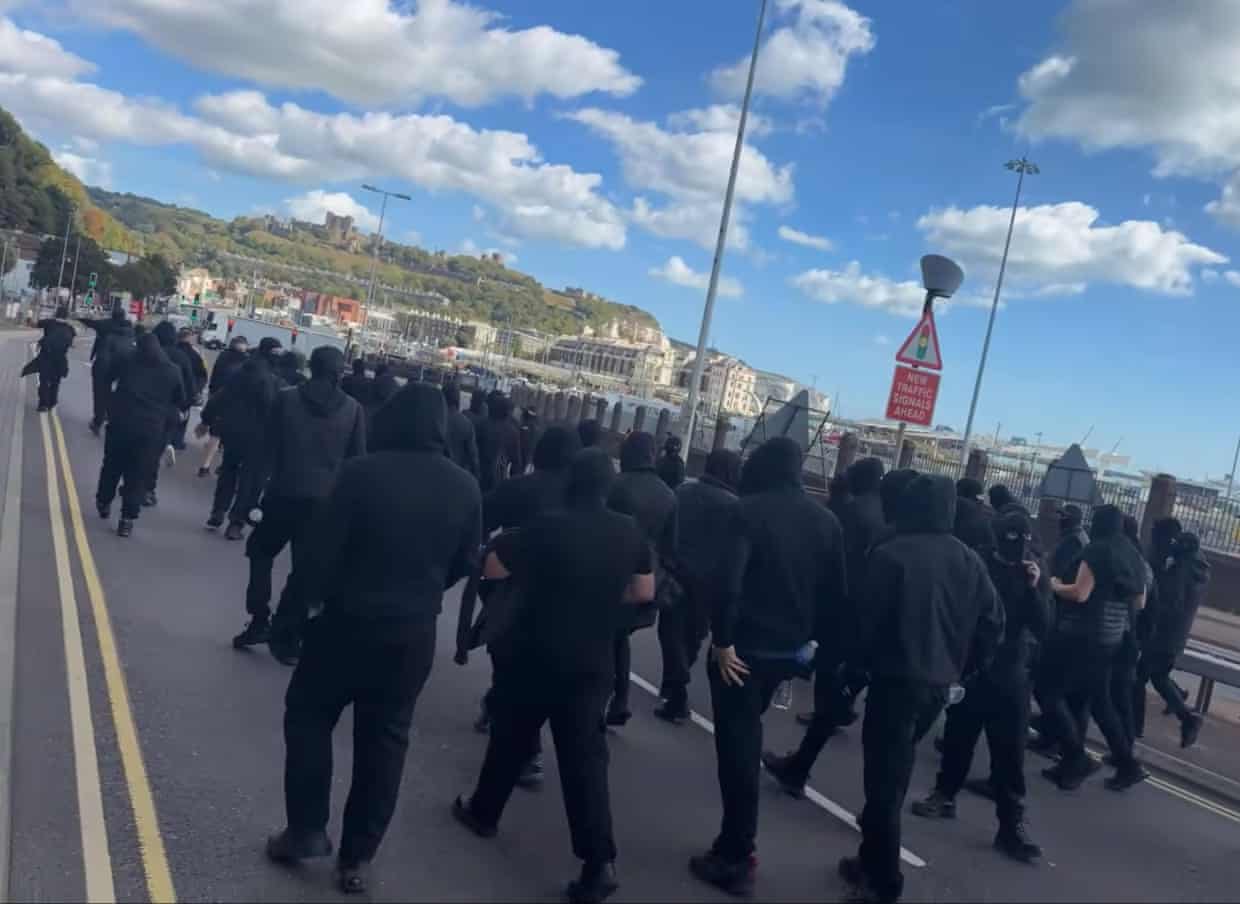
A masked far-right mobilisation blocked roads around the Port of Dover on Saturday morning, disrupting workers, residents and travellers while claiming to act in defence of the country.
Dozens of people dressed in black and wearing balaclavas linked arms across the A20 and marched along the road chanting “stop the boats” and “England till I die”. One witness estimated that about 300 people were involved, although police haven’t provided an official figure.
Traffic was stopped in both directions, producing four miles of congestion and delays of up to 30 minutes. Port workers finishing night shifts were reportedly prevented from leaving, ferry passengers missed their sailings and the Dover Waterfront parkrun was cancelled. The demonstrators dispersed by lunchtime and access to the port was restored.
The blockade appears to have been organised by Patriot Platform, an anti-immigration group founded by far-right activist Danny Thomas, also known as Danny Tommo. Thomas had spent the preceding days promising his followers that an unnamed action would send the government a “message”.
Tommy Robinson, whose real name is Stephen Yaxley-Lennon, promoted livestreams of the blockade and urged supporters to “get there to support them”.
He wrote: “Simultaneously at different locations across Dover patriots have mobilised to close down the port. There are 3 plus locations that patriots have shut down so far with many more planned to be closed. People wanted action I’m guessing there are 100,000’s of men willing to fill their shoes.”
The uniforms, concealed faces and coordinated roadblocks were intended to project the image of a disciplined force taking action where the government supposedly refuses to. Yet the practical targets weren’t the people who own Britain, determine wages, raise rents or strip public services. They were lorry drivers, port workers, local residents and passengers.
That’s the far right’s function in capitalist society. It takes the real anger produced by deteriorating living conditions and directs it away from the class responsible. Employers hold down pay, landlords raise rents, privatised monopolies inflate bills and successive governments impose cuts, but the migrant is presented as the cause of every shortage.
Its nationalism offers class collaboration in place of class struggle. The British worker is told that they share a common interest with British bosses, landlords and millionaires because they belong to the same nation. Meanwhile, migrant workers and refugees are placed outside this imagined national community and blamed for conditions they had no part in creating.
Thomas framed this movement in terms of blood and ancestry, speaking of “men and women of this country, who have the blood that runs through them like their grandfathers”. His appeal treats the country as a racial inheritance rather than a society divided into classes with opposing interests. A British capitalist exploiting thousands of workers becomes part of the national family, while a worker born elsewhere becomes an invader.
The slogan “stop the boats” also hides the imperialist system that forces people from their homes. Britain’s ruling class has spent generations extracting wealth from the oppressed world and supporting wars, sanctions and political interference wherever its interests demanded it. The poverty, instability and displacement created by that system are then presented as foreign threats when some of their victims reach Britain.
Capital and commodities pass through ports under the protection of the state. Human beings fleeing the consequences of imperialism encounter detention, deportation and organised political hatred. The same capitalist order that internationalises production and sends wealth across borders insists that workers view one another as enemies divided by nationality.
The official response offered no serious challenge to this politics. Labour MP Mike Tapp treated the mobilisation mainly as an irritation and boasted about the government’s record on border enforcement.
He wrote: “Parkrun cancelled and port access disrupted. I am fed up with idiots coming to Dover to cause disruption. I bet if you asked any one of those ‘protesters’ they wouldn’t know small boat crossings are down by 40 percent and we are working hard to fix the mess. Go home, enjoy your weekend/get a job.”
Tapp condemns the far right’s methods while accepting its central premise: that people crossing the Channel constitute a “mess” and that Labour’s answer is to reduce their numbers more efficiently. The argument becomes a competition over who can be tougher on migrants rather than an exposure of the class forces producing insecurity and directing public anger towards the most vulnerable.
The Home Office likewise condemned the disruption while repeating the standard claim that peaceful protest is “fundamental to our democracy”. Conservatives focused on the intimidation caused by masked men blocking vehicles, while a Reform UK councillor simply identified it as a “stop the boats protest” and advised residents to stay away.
There’s no contradiction between capitalist politicians condemning an unauthorised blockade and maintaining the anti-migrant politics that nourishes it. The government wants border repression administered through the state. The far right demands that self-appointed “patriots” impose it in the streets. Their methods differ, but both turn displaced people into the enemy and leave capitalist power untouched.
The Dover blockade provided a concentrated picture of far-right politics. Its participants dressed as enemies of the establishment but made no demand against capital. They obstructed workers, intimidated residents and directed their anger towards people with even less power. Beneath the balaclavas and martial rhetoric lies a familiar service to the ruling class: convincing workers that their enemy arrives in a small boat, so they don’t look at the class that owns Britain.