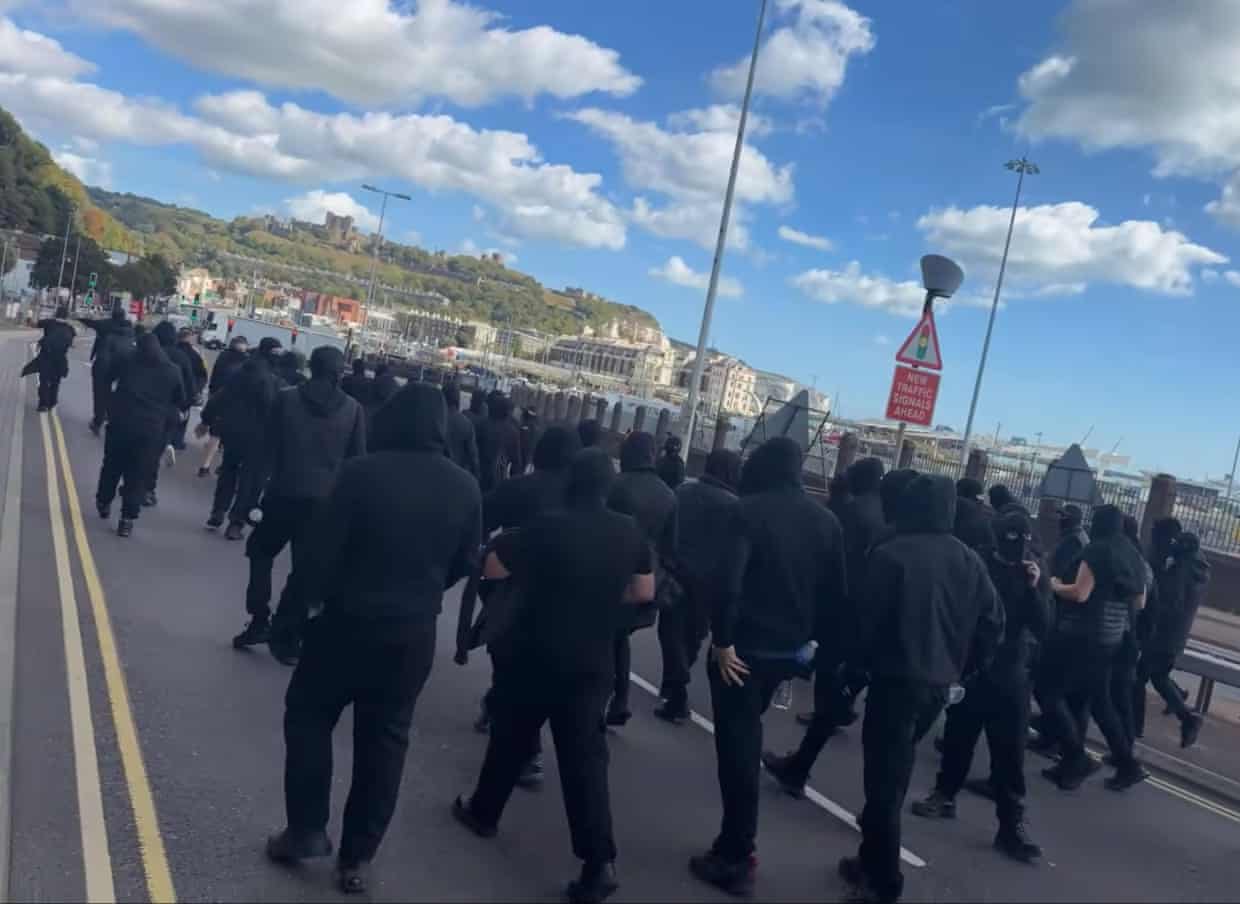
Hundreds of masked far-right activists blockaded roads around the Port of Dover on Saturday morning without a single arrest being made.
Dressed uniformly in black and wearing balaclavas, the protesters linked arms across the A20 and other approaches to Britain’s busiest international passenger port. Traffic was stopped in both directions, queues stretched for four miles and ferry passengers faced delays. The group marched through Dover chanting “stop the boats” and “England till I die.” The port said the disruption affected every route into and out of the town.
Kent Police described the blockade as a “spontaneous protest”. Officers followed the marchers and spoke to them, but made no arrests. By midday the protesters had dispersed, with many escorted by police to Dover Priory railway station.
The force announced: “No arrests were made. Traffic is flowing normally, and all involved had dispersed by midday.” Some passengers at the station said the masked group looked like a paramilitary formation and made them feel threatened.
Police even had the power to establish a designated area in which concealing your identity would itself become an offence. The Crime and Policing Act 2026 allows an inspector to create such a zone where a protest is expected to involve criminal offences. Kent Police hasn’t said that it used this power against the hundreds of balaclava-wearing men blocking the port.
The claim that the action was spontaneous is difficult to reconcile with the available evidence. Responsibility was claimed by Patriot Platform, a far-right network founded in June by Daniel Thomas, also known as Danny Tommo, an associate of Tommy Robinson. Participants arrived dressed alike, occupied several locations at once and were reportedly directed using walkie-talkies. One witness described a man cycling between the protesters and police positions, apparently monitoring the police response.
Three days before the blockade, Thomas told followers that he had been meeting a large group to prepare a “message” for the government. Tommy Robinson then announced during the action that activists had mobilised simultaneously at several locations around Dover and encouraged more supporters to join them.
Patriot Platform presents itself as a national “resistance” movement prepared to put “boots on the ground”. Thomas has appealed to inherited national identity by talking about people “who have the blood that runs through them like their grandfathers”. This is the familiar language of reaction: the nation is treated as a community of blood, while those born outside it are marked as an alien presence.
Nor was Thomas unknown to the authorities. Earlier in the year, he had publicly announced another plan to close Dover. He was arrested at the port in April after entering an area closed to the public while filming asylum seekers and later said he faced five charges, including aggravated trespass. Yet when hundreds of his movement’s supporters appeared in matching clothes and shut several roads at once, police claimed they’d been caught by surprise.
Compare this treatment with the response to a much smaller climate protest three days earlier.
On 2 September, Just Stop Oil supporters sat down in Parliament Square to demand an end to new oil and gas developments. Some glued themselves to the road. The Metropolitan Police had confirmed 47 arrests by 4.13pm, while Just Stop Oil said at least 60 people were eventually arrested.
The basic tactic was the same: non-violent obstruction of a road. At Dover, however, the blockade involved several times as many people and disrupted access to a major port. The masked far right were escorted to the railway station. Climate protesters were carried into police vans.
The contrast is still sharper when set against the treatment of anti-genocide protesters. On 11 April, police arrested 523 people aged between 18 and 87 at a seated demonstration in Trafalgar Square. They sat on the ground or on camping chairs holding placards reading: “I oppose genocide. I support Palestine Action.”
Those demonstrators weren’t arrested for assault, intimidation or property damage. They were arrested under terrorism legislation for displaying support for a proscribed organisation. The arrests continued even after the High Court ruled that the government’s ban on Palestine Action had been disproportionate and unlawful, because the government was permitted to appeal the judgment.
The scale of this repression is extraordinary. Home Office figures show that 3,021 terrorism-related arrests were made in the year ending March 2026, compared with 6,539 during the entire period since September 2001. The enormous increase followed the proscription of Palestine Action and the mass arrest of people quietly holding anti-genocide placards. Defend Our Juries says more than 3,600 people have now been arrested in connection with opposition to the ban.
This isn’t simply a story about police incompetence or inconsistent application of the law. The law is never applied outside politics, and politics is never separate from class power.
The capitalist state presents the police as neutral defenders of an abstract “public order”. But public order under capitalism means the preservation of capitalist property, imperialist interests and the authority of the institutions that defend them. This is part of what Marxists mean when we describe liberal democracy as a dictatorship of the bourgeoisie. Individual officers don’t need to receive instructions from oil executives or arms manufacturers. The institutions, laws and political priorities of the state have already been shaped around the needs of the ruling class.
Climate protesters challenge the freedom of fossil-fuel capital to continue extracting profit while the planet burns. Anti-genocide protesters expose Britain’s support for Israel and attack the political legitimacy of an imperialist order that arms and protects the perpetrators of genocide. Even when their methods are limited to sitting in a road or holding a cardboard sign, the state recognises the interests being challenged.
The far right plays a different role. Its members may call themselves anti-establishment, but their politics leave capitalist power untouched. They don’t blame landlords and property companies for unaffordable housing. They blame migrants. They don’t blame privatisation and austerity for collapsing public services. They blame asylum seekers. They don’t blame employers for low wages or the ruling class for concentrating wealth in its own hands. They tell British workers that their enemy is another section of the working class.
This is class collaboration dressed up as rebellion. The far right invents a shared national interest between exploited workers and the capitalists exploiting them, then turns the anger produced by capitalism against refugees and migrant workers. Its politics divide the proletariat while protecting the social relations responsible for its misery.
The people crossing the Channel don’t appear from nowhere. Many have been displaced by wars, sanctions, environmental destruction and unequal economic relations imposed by the imperialist powers. “Stop the boats” removes those causes from view. Britain’s rulers can bomb, sanction and plunder abroad, while the far right patrols the imperial centre demanding punishment for those who arrive at its borders.
The Dover action obstructed the movement of traffic, but its political demand posed no threat to capitalist ownership or British imperialism. It demanded a harsher version of the border regime the state already operates. Its immediate targets were some of the most powerless people in society.
This doesn’t mean the bourgeois state will never arrest far-right activists. It will repress them when their disorder becomes sufficiently inconvenient or threatens to escape its control. But Saturday’s events show that disruption isn’t measured neutrally. Blocking a road in defence of the climate produces dozens of arrests. Sitting with an anti-genocide sign can make a pensioner a terrorism suspect. Hundreds of masked men can close access to a major port and receive a police escort to the station.
Patriot Platform called the blockade a warning. The more revealing warning came from the state itself: it showed which forms of opposition it considers dangerous and which ones it can afford to handle with patience.