
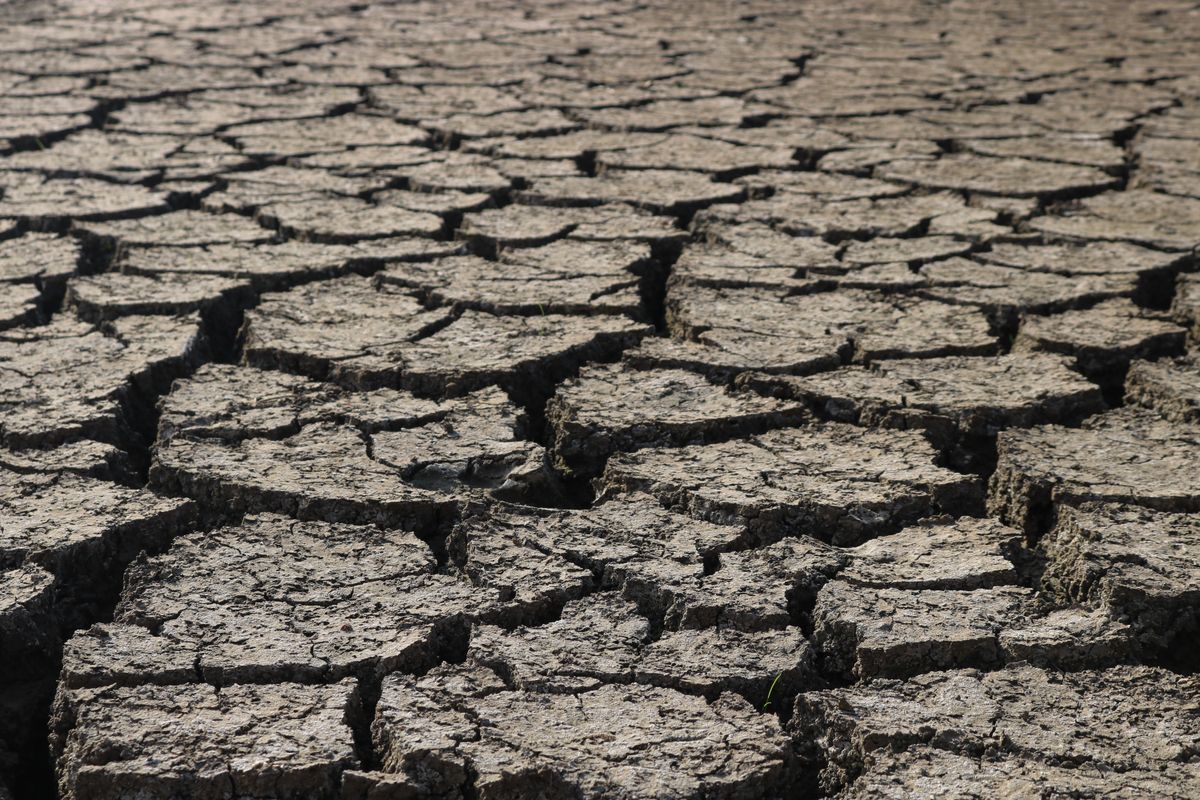
The British government has warned foreign ministers that climate breakdown and collapsing ecosystems threaten food supplies, water, migration and international stability. Yet the intelligence report behind the warning remains hidden from the British public.
Foreign secretary Ed Miliband presented the findings to ministers from the EU, Kenya and other countries during a private meeting at the UN general assembly in New York. The research, produced by the UK’s intelligence agencies, reportedly warns that the destruction of natural systems such as the Amazon and Congo rainforests will contribute to food shortages, displacement and conflict around the world.
Miliband said the coming El Niño had been intensified by global heating and would place unprecedented strain on the world’s food systems.
“We face an El Niño that is already set to be the most intense in living memory,” he said. “This will intensify climate shocks that compound and cascade across borders, threatening food and water security, displacing communities, putting pressure on markets and scarring economies.”
This year’s heatwaves, poor harvests and rising food prices have already provided a warning of what lies ahead. Climate breakdown is no longer treated within the British state as a distant environmental concern. It’s being discussed as a direct threat to the functioning of capitalist economies and the stability of the existing international order.
“Climate change and nature loss have never been issues for climate and environment ministers alone,” Miliband said. “They are defining challenges for our citizens, our economies, our foreign policy and our national security.”
That language reveals how the ruling class understands the crisis. The loss of lives, homes and livelihoods becomes politically urgent when it begins to threaten markets, borders and state power. Governments that have tolerated decades of environmental destruction are now preparing for the social consequences.
Capitalism treats nature as an apparently limitless store of raw materials and a dumping ground for waste. Forests, land, water and fossil fuels are assigned value according to whether capital can turn them into profit. The long-term conditions required to sustain human life remain secondary because each individual firm is compelled to accumulate, expand and beat its competitors.
Marx described this destructive separation between human society and the natural conditions of production as a rupture in the metabolic relationship between humanity and nature. Under capitalism, production isn’t consciously organised around social need or ecological limits. It’s directed by private profit, even where the collective consequences are already understood.
The British state plainly understands those consequences. The Joint Intelligence Committee report was due to be published last October, but Downing Street suppressed it on the eve of its release under Keir Starmer. Only a redacted version appeared in January after a Freedom of Information request. Ministers have continued to withhold the complete report.
The secrecy reflects the class character of the capitalist state. Information with consequences for the whole population is treated as the private property of ministers, intelligence agencies and military officials. The public is expected to endure the coming disruption without being allowed to see the state’s full assessment of it.
Green Party MP Adrian Ramsay, who has campaigned for publication, said: “It’s good that the foreign secretary is presenting the findings of this crucial report to ministers from other governments.
“But it begs the question, why are MPs in this country still being denied access to the full report? And, most importantly, why has our government still not published its response to how it will address the stark findings?”
Retired general Richard Nugee argued that climate damage should be treated like hostile action against national infrastructure.
“If a bridge is washed away, it has the same impact whether it’s done by [a foreign power] or the climate,” he said. “The climate crisis will affect food security, energy security, water security, and lead to migration and potentially the recruitment of farmers to [terrorist organisations such as] Isis. Countries should absolutely be treating this as a national security issue.”
But the climate isn’t a foreign power attacking Britain. Bridges aren’t being washed away by an enemy with intentions of its own. Climate breakdown is the accumulated result of a system built around fossil fuels, industrial agriculture, deforestation and endless commodity production.
Presenting it primarily as a national security threat obscures that cause. It also encourages governments to treat displaced people, hungry populations and social unrest as security problems to be contained. The victims of environmental destruction become potential migrants, recruits or sources of instability, while the corporations and imperialist states most responsible remain protected.
The burden will not be distributed equally. Imperialist countries built their wealth through colonial extraction and continue to consume a disproportionate share of the world’s resources. Countries across Africa, Asia and Latin America are left more exposed to crop failures, floods and water shortages while carrying debts that restrict public investment. Their land and minerals are still subordinated to the needs of foreign monopolies and financial capital.
The destruction of the Amazon and Congo rainforests can’t therefore be separated from imperialism. These ecosystems are not collapsing because humanity collectively made a series of poor consumer choices. They’re being consumed by mining, logging, agribusiness and infrastructure projects shaped by the world market and the accumulation of capital.
With Prime Minister Andy Burnham’s backing, Miliband has promised to place climate and nature at the centre of British foreign and security policy. He told the private meeting:
“The countries fit for the future will be those that see climate and nature as intrinsic to economic and national security. Countries that anticipate risks and invest in resilience before crises hit.
“Countries that seize the incredible opportunities the clean energy transition presents. Countries that don’t just see the connections but act on them.”
The reference to “incredible opportunities” gives the game away. Even as environmental collapse threatens millions, the transition is presented as another field for profitable investment. Energy systems, minerals, patents and new technologies become objects of competition between corporations and states. The same drive for accumulation that produced the crisis is repackaged as its solution.
British capitalism may invest in flood defences, secure supply chains and military planning where its own interests are threatened. It may also use climate policy to support British monopolies in new markets. None of this amounts to organising production around the needs of people and the planet.
The intelligence agencies can predict food shortages, displacement and conflict. Ministers can discuss those predictions behind closed doors. What the capitalist state can’t admit is that the system it exists to defend is driving the catastrophe it now calls a threat to national security.